
When communities search for a new HOA management company, the conversation usually focuses on pricing, responsiveness, inspections, or board support. Those are all important factors — but there is another question boards should be asking that often gets overlooked:
What software does the management company use to manage the association?
The answer can have a major impact on financial transparency, collections, owner records, reporting capabilities, and even how smoothly a future management transition occurs.
At first glance, many management companies may appear similar. However, the operational infrastructure behind the scenes can vary dramatically between a professional association management platform and consumer-grade accounting software that was never designed for HOA operations.
Not All Accounting Software Is Built for HOAs
Some smaller or family-run management companies still rely on generic accounting software such as Quicken or other entry-level bookkeeping tools. While these programs may work for basic checkbook accounting, they often lack critical HOA-specific functionality.
That limitation may not become obvious until a board requests information that should be standard in community association management.
For example:
- Complete owner ledgers
- Delinquency tracking
- Violation histories
- Architectural review records
- Assessment roll reporting
- Collection activity history
- Resale certificate data
- Bank reconciliation detail
- Audit-ready financial records
- Multi-year owner transaction histories
In some transitions between management companies, incoming managers discover that these records either:
- cannot be exported properly,
- were never maintained consistently,
- or exist only in fragmented spreadsheets and manual notes.
That creates unnecessary risk and operational headaches for the association.
Owner Ledgers Should Not Be Optional
One major red flag is when a management company cannot easily provide a full set of owner ledgers during a transition.
In a professionally managed HOA, individual owner ledgers are foundational records. They document:
- assessment charges,
- payments,
- late fees,
- credits,
- collection activity,
- fines,
- and account balances for every property.
These ledgers are essential for:
- accurate collections,
- dispute resolution,
- resale certificates,
- financial audits,
- and management transitions.
If a management company says they have “never been asked” to provide owner ledgers before, boards should ask a deeper question:
Does the software they use actually support proper HOA accounting and reporting?
In many cases, the issue is not unwillingness — it is that the software platform simply was not designed to manage community associations at scale.
HOA Management Requires HOA-Specific Systems
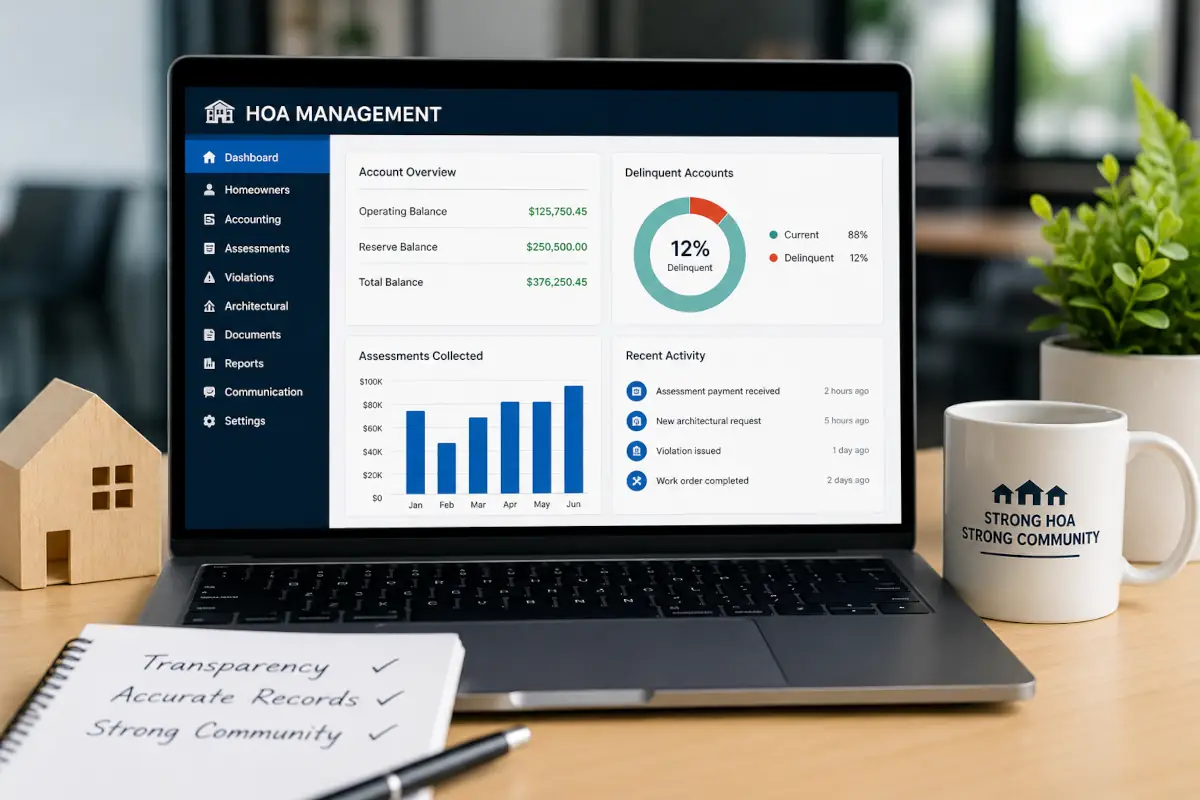
Professional HOA management platforms are built specifically for the operational complexity of community associations. They typically include:
- integrated owner databases,
- assessment automation,
- violation tracking,
- architectural review workflows,
- vendor management,
- board portals,
- homeowner portals,
- collections integration,
- document storage,
- and robust financial reporting.
These systems also create operational continuity. If a manager leaves, the association’s records remain centralized and accessible.
That is very different from a system built around one person’s manual processes or local desktop accounting files.
Why This Matters During Management Transitions
Communities often discover software limitations only after deciding to switch management companies.
At that point, the association may encounter:
- incomplete financial records,
- missing owner histories,
- difficulty validating balances,
- manual data reconstruction,
- or delays onboarding into the new management platform.
This can create:
- confusion for homeowners,
- delays in collections,
- accounting discrepancies,
- and additional costs for the association
A modern HOA management platform helps avoid these problems by maintaining organized, exportable, association-owned data.
Questions Every HOA Board Should Ask
When interviewing a management company, boards should consider asking:
- What software platform do you use for HOA management?
- Is the software specifically designed for community associations?
- Can you provide sample owner ledgers and financial reports?
- How are violations, ACC requests, and collections tracked?
- Do homeowners and board members have portal access?
- How is data transferred if the association changes management companies?
- Are records cloud-based and association-owned?
- Can the system support audits and long-term document retention?
A professional management company should be able to answer these questions clearly and confidently.
Technology Impacts Transparency
Good software does not guarantee good management.
However, outdated or inadequate software often limits transparency, reporting, accountability, and scalability.
As communities become more sophisticated — and homeowners expect online access, faster communication, and better financial visibility — technology matters more than ever.
An HOA board is not simply hiring a manager. It is selecting the operational infrastructure that will support the association’s finances, records, and governance for years to come.
Before signing with a management company, make sure you understand not only who will manage your community — but also what systems they will use to do it.
If you are looking for a new association management company we offer both full management and financials only (for those that are trying to reduce expenses and don't need full service). We use CINC Systems as our association management platform. Reach out to us for a consult or proposal: PMI Metroplex Properties